overview: marine microbes & carbon flux
Each year, unicellular algae (aka, phytoplankton) in the oceans generate nearly as much organic carbon as plants on land. About half of this phytoplankton-derived carbon (~20 Gt C) is degraded by heterotrophic bacteria within minutes to weeks, through a process referred to as the microbial loop. This trophic transfer between phytoplankton and bacteria accounts for the largest flux of carbon through the ocean and regulates the balance between remineralization to CO2 and carbon storage in the deep ocean. We are interested in understanding the metabolic & ecological networks between the microorganisms and substrates that mediate this large flux of energy and matter.
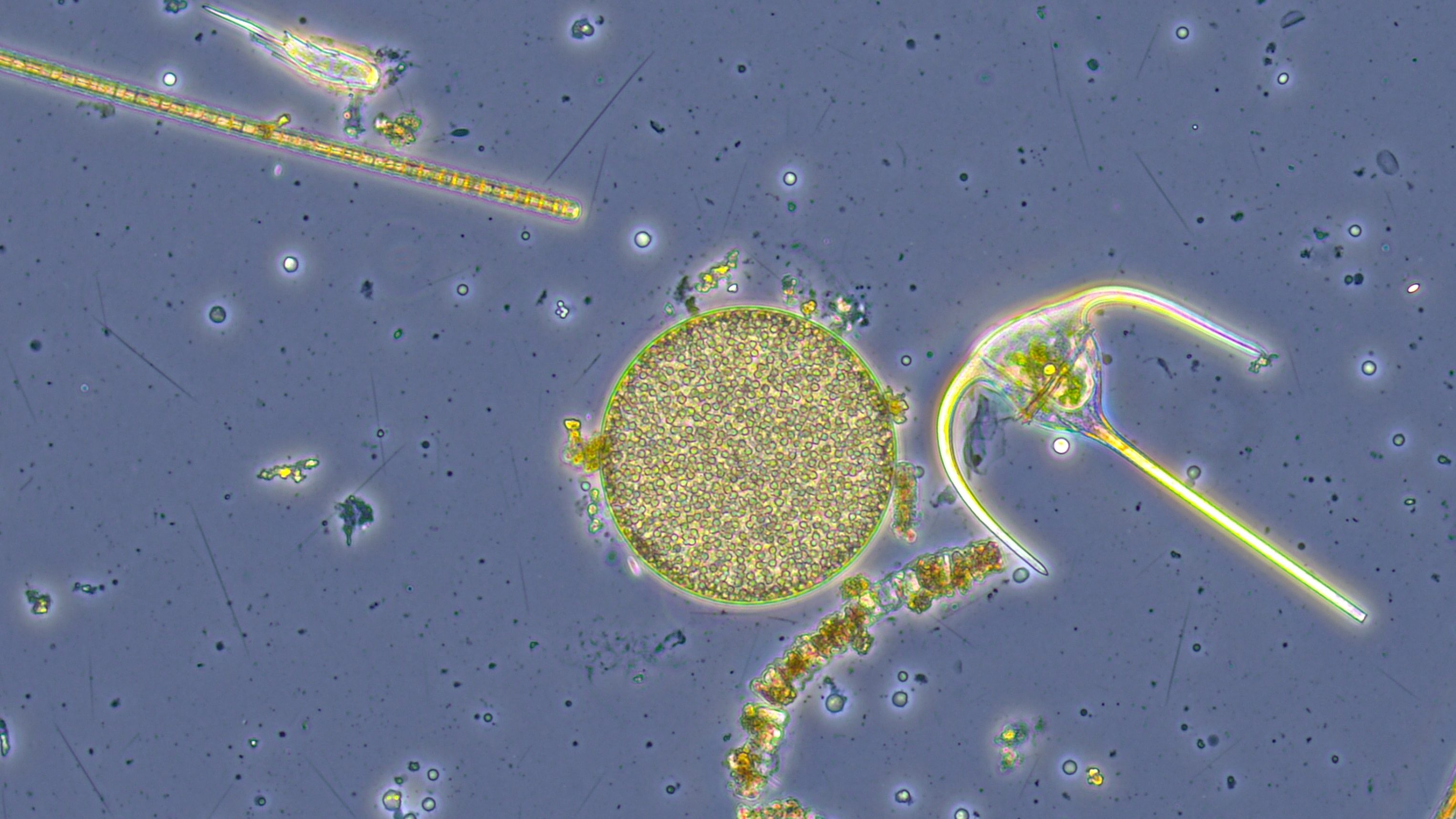
Plankton under microscope. Photo credit: Rebecca Key.
model systems approaches to study marine microbe-microbe interactions in the lab
To explore metabolite exchange in phytoplankton-bacterial interactions, we employ model microbial system approaches where marine phytoplankton and bacteria are co-cultured together in the lab. Then, gene expression (transcriptomics) and chemical analyses (metabolomics) are used to assay for compounds passed between the two organisms. Through these approaches, we have detected complex signaling dynamics and exchange of novel organosulfur molecules (sulfonates) between diatoms and bacteria. Genes for biosynthesis and degradation of sulfonates have limited distribution among phytoplankton and bacteria, respectively, suggesting that sulfonated substrates underlie targeted microbial interactions. While we routinely use model-system species in lab experiments to study microbial interactions (e.g. diatom Thalassiosira pseudonana), we also examine Harmful Algal Bloom (HAB)-forming species and isolates from the field.
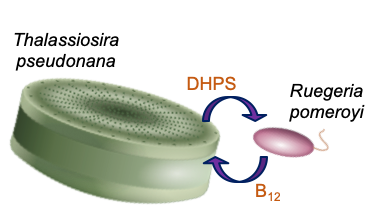
In a two-member model system between the diatom T. pseudonana and the bacterium R. pomeroyi, transcript and metabolite patterns reveal exchange of the diatom-derived sulfonate DHPS (dihydroxypropane sulfonate).
field-based ‘omics measurements to decipher microbial community activity
We use field-based observations to examine structure and function of microbial metabolic networks in natural communities. Current projects involve integration of data on microbial diversity (e.g., DNA amplicons), organic molecules (e.g., metabolomes), gene expression (e.g., metatranscriptomes), and biogeochemistry (e.g., net community production, particulate organic matter). For example, combining environmental measurements of cellular metabolite and transcript abundances has allowed us to “watch” metabolite cycling by simultaneously tracking compound abundances inside plankton cells along with gene expression in the phytoplankton and bacterial taxa that synthesize and catabolize them, respectively. These integrative approachs allow us to better understand how microbial interactions and metabolite exchange contribute to marine carbon flux and ecosystem interdependencies.
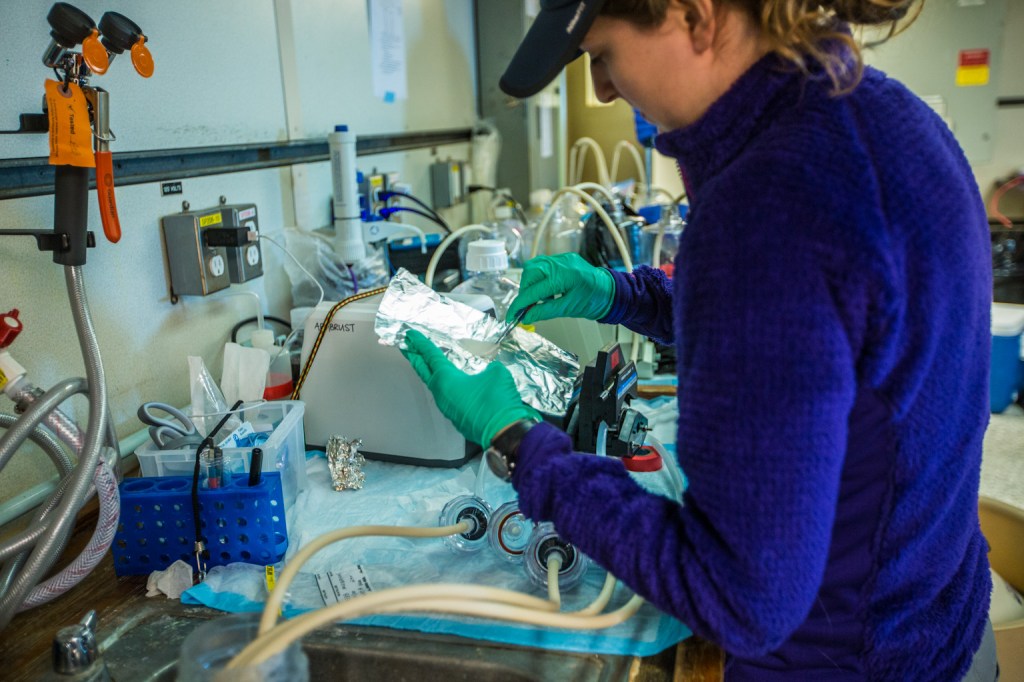
Collection of plankton samples onboard the Research Vessel Thomas G. Thompson; Photo credit: Robyn Von Swank.
organic sulfur metabolisms
We are broadly interested in understanding the flow or organic sulfur between marine phytoplankton and bacteria. Concurrent with an expanding repertoire of newly recognized sulfur currencies (e.g., sulfonates), the oceanography community has recognized a large inventory of organic sulfur in the ocean that is poorly characterized yet its transformation influences ocean and atmospheric chemistry. While phytoplankton-derived organic matter has historically been thought of in terms of its carbon, nitrogen, and phosphorus content, we now recognize that sulfur is a substantial component of phytoplankton stoichiometry with one sulfur atom assimilated into biomass for every 95 atoms of carbon. Indeed, sulfur metabolism is fundamental to phytoplankton physiology. Using combined laboratory and field observations, we are interested in defining the organic sulfur pool, identifying genetic pathways of organic sulfur metabolism in marine microbes, and quantifying the contribution of organic sulfur to marine carbon and energy flux.

Deployment of the CTD niskin rosette onboard the Research Vessel Walton Smith; Photo credit: Lisa Coe.
 DURHAM LAB